Cookie
FlexiHub Team uses cookies to personalize your experience on our website. By continuing to use this site, you agree to our cookie policy. Click here to learn more.
Olga Weis Olga Weis Last updated Sep 10, 2026
Technically reviewed by Nikolai Svarachevsky, Lead Developer at FlexiHub, who has personally tested USB-over-network connections.

Efficiently Share USB Devices: Over The Network & Between 2 Computers

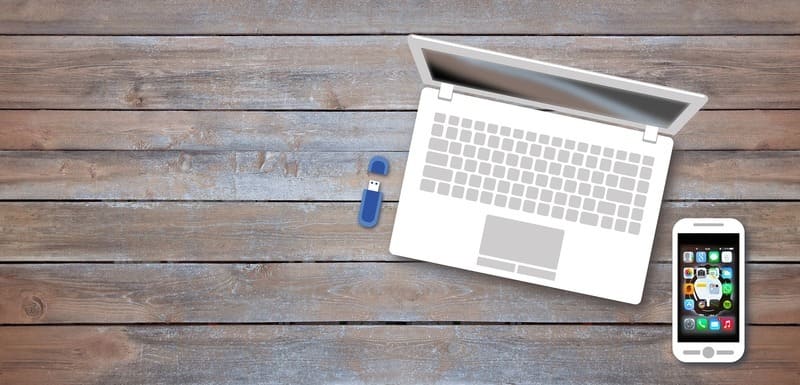
The most efficient way to share a USB device depends on the physical distance between the computer with the device plugged into it and the one you're trying to access the device from.

In this article, we're going to cover both long-distance USB sharing over the network, and short-distance USB sharing with the help of a hardware USB switch. Find out more about the pros and cons of each method to decide what will best suit your specific situation.
Share USB devices
Note: How We Tested FlexiHub

We tested FlexiHub 7.0.15594 between two Windows 11 computers connected to the same Gigabit Ethernet network. Three USB devices were attached to the host PC: an HP LaserJet Pro M404dn printer, a Logitech C920 webcam, and a SanDisk Ultra Flair 64 GB flash drive.

From the second PC, we connected each device through FlexiHub using a direct connection. We printed a 10-page PDF, checked a 1080p webcam feed, and copied a 1 GB file from the flash drive. Each test was repeated three times to check that the devices connected and worked consistently.

Sharing USB over the network

At some point, you might need to access a printer, scanner, webcam, or dongle key plugged into another computer. If that computer is within your reach, there won't be too hard to reconnect the device from there to your machine.

But what if you'll have to do that with multiple devices dozens of times a day every day? It will be extremely inconvenient, and the level of wear and tear your devices will be subjected to with constant replugging substantially reduces their lifespan. And what if another machine is located miles away, so you'll have to drive for hours there and back to reattach the device?

That's when USB sharing software will come in handy.
FlexiHub
4.8 Rank based on 386+ users
share usb over network
FlexiHub is rightly considered to be one of the most convenient and easy-to-use USB device-sharing software tools today's market has to offer. With its help, you can not only access USB peripherals attached to remote machines but also make your local devices accessible over the network in a couple of mouse clicks.

How does FlexiHub work?

By using FlexiHub, you'll be able to share a USB over the network regardless of the distance between them - whether they are located in different rooms or the opposite hemispheres.

FlexiHub works by virtualizing a USB device and transmitting data to the remote computer over the network. There, FlexiHub converts the TCP/IP packets back to conventional USB data.
Here are just some of the main FlexiHub features you can benefit from:
  • Cross-platform: FlexiHub will provide you with smooth, trouble-free connectivity to real and cloud-based virtual machines that run on different OS platforms.
  • Surefire connectivity: thanks to the private redirection server, you can connect USB devices even if a machine has no public IP address or is hidden behind NAT.
  • Top security: all USB traffic is encrypted with TLS 1.2 to protect it from unauthorized access. Unlike outdated SSL, TLS 1.2 is the current, actively maintained encryption standard, which is why FlexiHub uses it.
  • Traffic optimization: you can choose the level of data compression you prefer, depending on how many bandwidth- and latency-sensitive devices you use.
  • Auto Reconnect: enable this option in Settings before connecting, and if the internet connection drops, FlexiHub will automatically re-establish it once connectivity returns.
  • Login tokens: grant other people access to your FlexiHub account without sharing your login credentials.

How to share USB devices over the network

For your convenience, we've created an easy-to-follow guide on what steps to take to share USB over the network:
  • 1.
    Register FlexiHub account
    Register your FlexiHub account to get a free demo. blank
  • 2.
    Download and install it
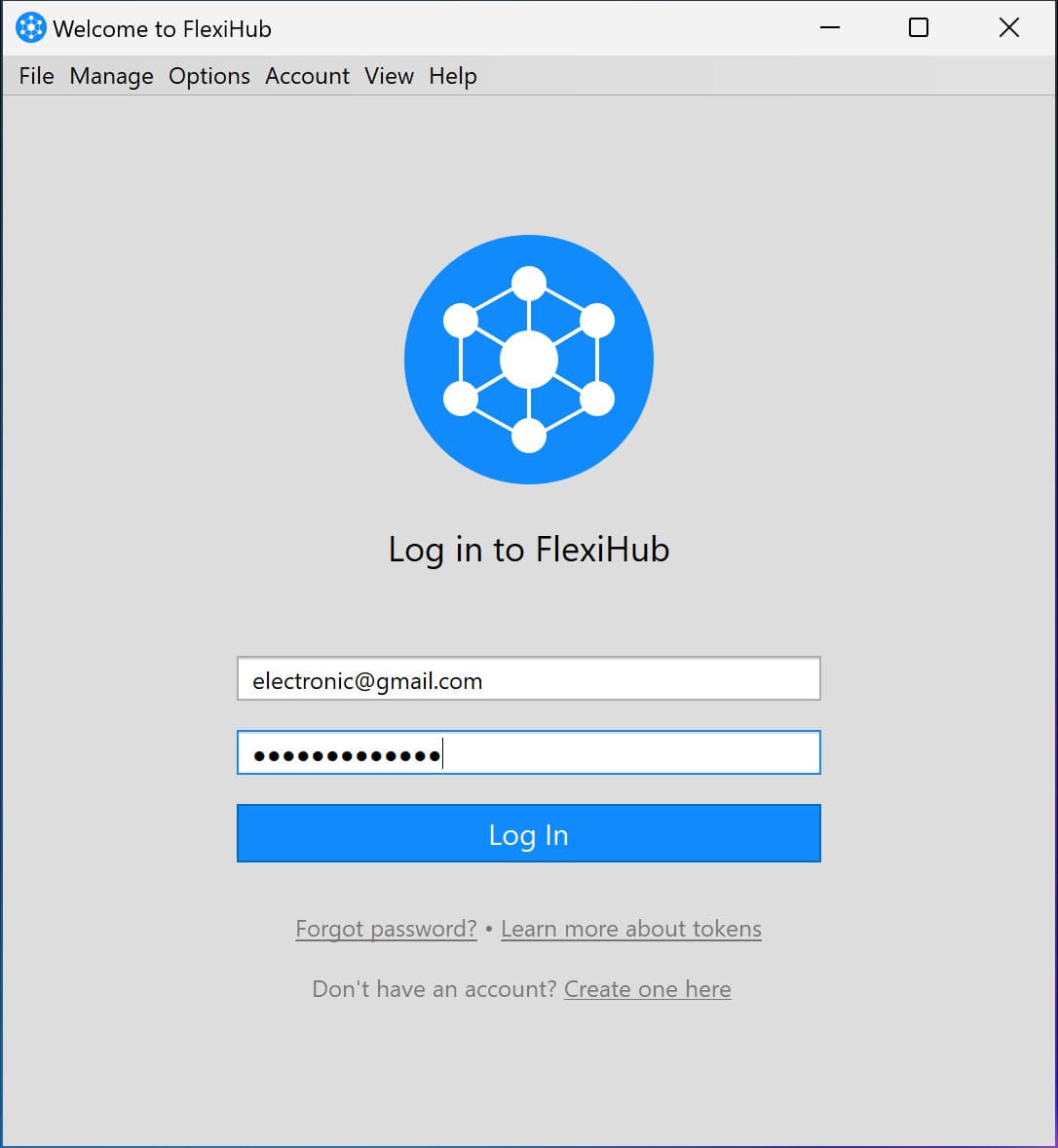
    Download FlexiHub and install it on the computer with a USB device you wish to share and also on all the computers that will connect to the device over the network. Once installed, launch the application and sign in to your account.
    launch and log in FlexiHub
  • 3.
    Connect device
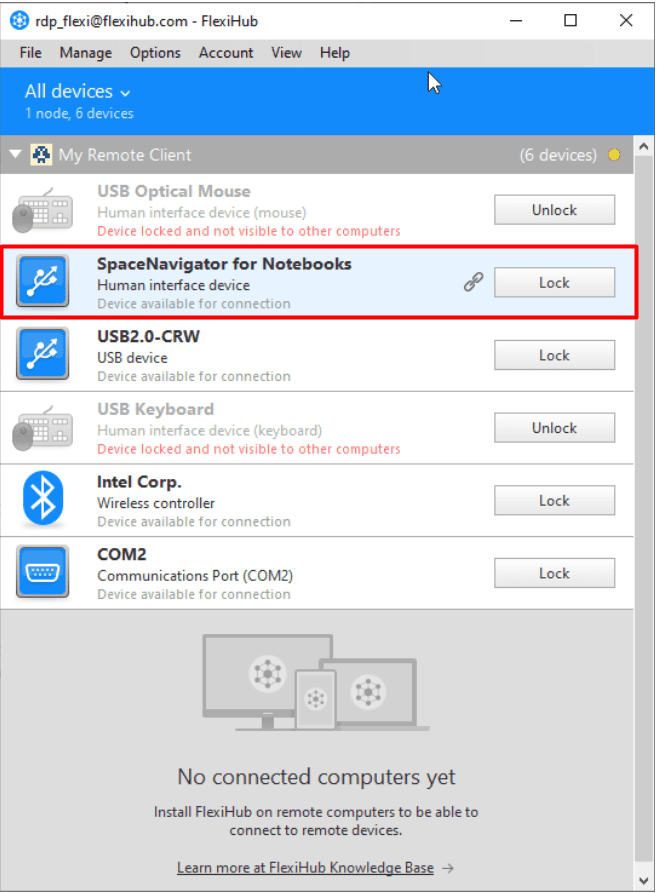
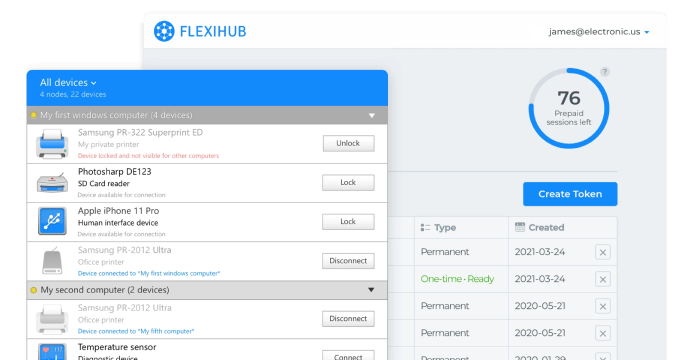
    On a remote computer, find your USB device in the list shown in the FlexiHub interface, and click the "Connect" button next to it.
    connect usb over network
  • 4.
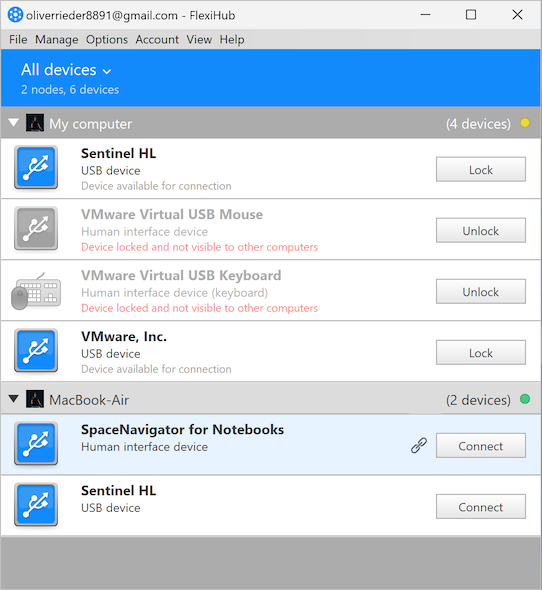
    That's it!
    That's how easy it is to arrange for a USB device located halfway around the world to show up in your computer's Device Manager.
    device connected in FlexiHub

FAQ: sharing USB over network

USB sharing is a process or action that lets you share USB devices and access them remotely over a network. In most cases, this can be achieved using purpose-specific software solutions that allow you to use remotely attached peripherals as if they were physically connected to your machine.
For sharing a USB device over the network, you need an Internet-connected computer, a cable to connect a USB device to the computer (if required), and a FlexiHub account. Attach the device to your local machine with a cable, and start FlexiHub. Then, run FlexiHub on the remote machine, find the device you wish to access, and click "Connect" next to its name. And that is how to access and share a USB device over the network.

USB switch - for sharing USB devices between two computers

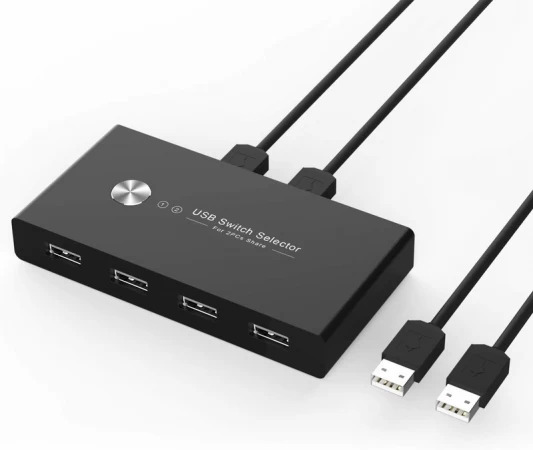
USB switch is a compact device for sharing one or more USB peripherals between two computers at the same time that are located near each other.
USB sharing switch
For instance, you can connect your office printer or MFD to a USB 3.0 sharing switch and make it accessible from your and your colleague's machines without having to reconnect any cables every time you need it.

Using a USB device switch doesn't require a network connection. You can share memory sticks, external drives, card readers, license dongles, etc., with other users and throw over a whole bunch of USB devices from one machine to another just at the push of a button.

Some USB switches also support Auto-Switch function when used with USB-enabled printer or printing function on a MFP (multi-function printer). With the switch software installed on connected computers, you simply send the print job and the switch will automatically makes the swap for you. This can be handy when the USB switch is located behind the desk or somewhere hard to reach.
Here's is an easy-to-follow guide on how to connect one USB device to two computers using a USB switch selector:
  1. Plug the USB device (or a USB hub with some devices attached) you'd like to share into the USB peripheral sharing switch.

  2. Now connect your USB switch between two computers you want to share USB peripherals with.

  3. Whenever you need to use your USB peripherals on another PC, just push the selector button on the switch to flip them over. And that would be it, as easy as one-two-three.
Recommended USB Switches for Two Computers

The picks below are based on specs and current market research. For a basic setup, the Sabrent USB-SW30 costs around $15-20 and lets two computers share one USB 3.0 device. It supports transfer speeds up to 5 Gbps and works with printers, external drives, and other USB peripherals. Switching is manual, using a button on the unit.

If you need to keep several peripherals connected, the UGREEN USB 3.0 4-Port Switch costs around $30-46 depending on the retailer and lets two computers share up to four USB devices, such as a printer, scanner, keyboard, mouse, or external drive. It also supports USB 3.0 speeds up to 5 Gbps and uses a button to transfer control of the connected devices between computers.

A hardware USB switch is a good fit for two computers sitting at the same desk. For computers in different rooms or locations, a network-based solution such as FlexiHub is more practical.

Are USB switches safe to use?

In most cases, using a USB switch hub is considered safe. These devices' failures have next to no chance to cause any physical damage to your PC or laptop because they do not use the power and data pins for USB 2.0 backward compatibility.

However, some of the cheap no-name USB A/B switch boxes use a USB-A port as an input which can potentially short the +5V lines on devices and can lead to cable overheating up to a fire hazard level. So unless you have special-purpose safe USB 3.0 debug cables to connect the USB switch between two computers, avoid purchasing and using devices with USB-A input.

What is best for USB sharing?

When choosing between software and hardware methods to share USB devices between multiple computers, here's how the two approaches compare:
FlexiHub (network)
Hardware USB switch
Distance Any distance, over the internet Same room only
Number of devices Multiple, governed by your subscription plan rather than physical ports Limited to the switch's port count
Setup Install the app on both computers Plug in cable, press a button
Ongoing cost Subscription One-time purchase
Network connection required checked checked
Hardware switches tend to win on upfront price, but FlexiHub's feature set, encryption, login tokens, cross-platform support, is worth it once you factor in the added functionality and security.

FAQ: sharing a USB device between 2 computers

Most of the USB switches in today's market are bidirectional. But to be extra sure, you need to check the device's specification before making a purchase.
There are two ways to share a USB device between 2 computers. If your computers are in the same room, you can use a compact and budget-friendly USB switch. If the distance is significant and a device cannot be connected directly, the most efficient way is to share a USB device over the network using FlexiHub.
USB HUB to extend USB through Ethernet
  • 4.8 overall rank based on 386+ users
  • Windows, macOS, Linux, Android and Raspberry Pi.
  • 11.63MB Size.
  • Version 7.0.15594. (19 May, 2026).
  • Pricing starts $39 per month billed annually